
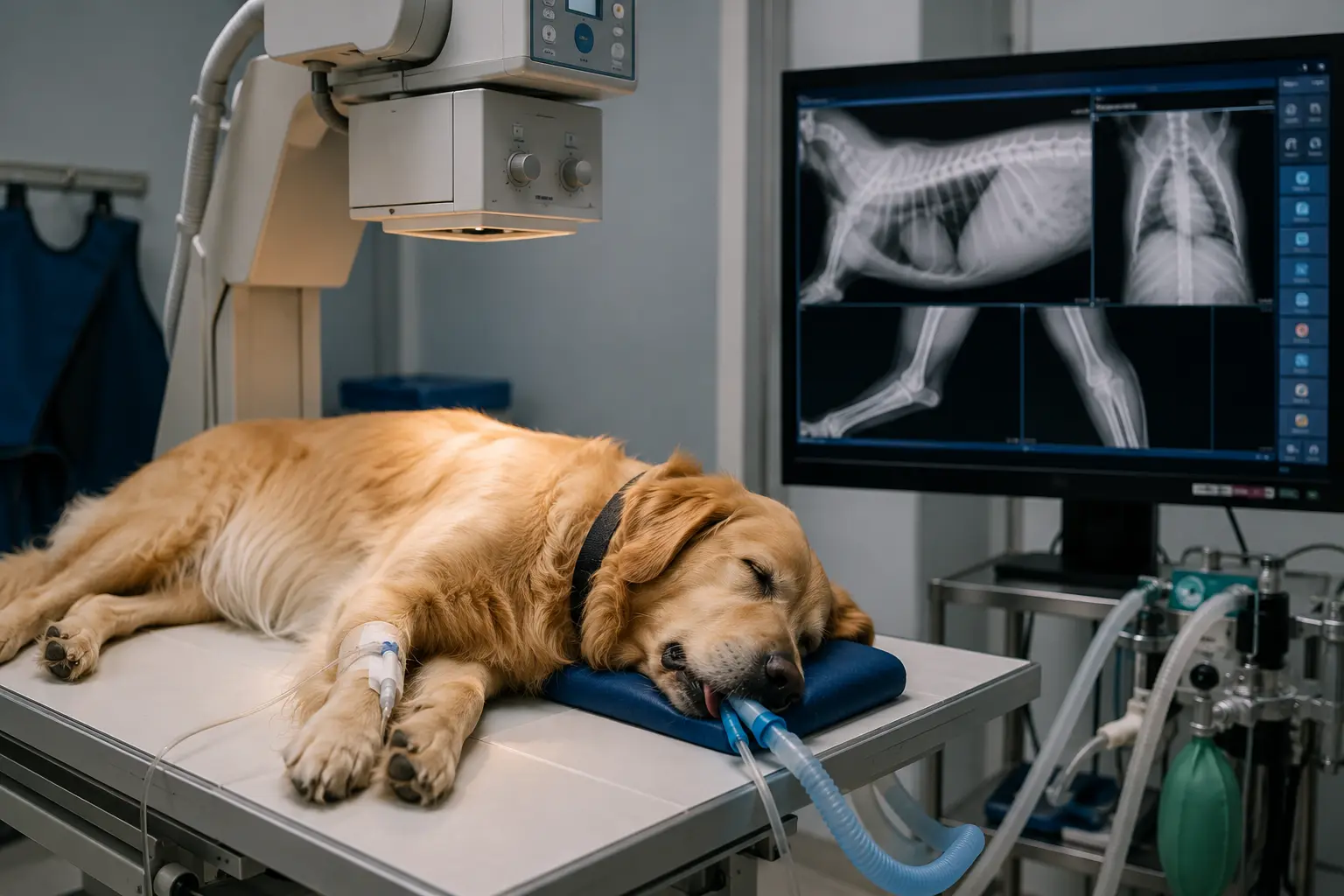
How Much Does a Dog X-Ray Cost?
A dog X-ray typically costs $150 to $500 for a standard study with two or more views. A limited single image may cost approximately $75 to $200.
When the veterinary examination, sedation, emergency fees, bloodwork, medication, or specialist interpretation are included, the complete appointment may cost $250 to $1,000 or more.
| Service | Estimated Cost | What It Usually Covers |
|---|---|---|
| Limited single X-ray view | $75 to $200 | One image, usually excluding the examination and treatment |
| Standard two-view or three-view study | $150 to $500 | Diagnostic images of one body area |
| Routine appointment with X-rays | $250 to $700 | Examination, imaging, and common minor charges |
| X-rays with sedation | $300 to $800 | Examination, imaging, sedation, and basic monitoring |
| Emergency evaluation with X-rays | $500 to $1,200 or more | Emergency examination, imaging, and common diagnostic services before major treatment |
These figures are US planning estimates rather than guaranteed prices. Veterinary charges vary by clinic, location, dog size, medical condition, number of images, and the services included in the estimate.
Before agreeing to the procedure, ask whether the quoted price covers only the X-rays or the complete appointment. The examination fee, sedation, medication, specialist review, and treatment may be charged separately. Review the average vet visit cost in 2026 when estimating the full bill.
What Affects Dog X-Ray Cost?
The final cost depends on the number of images, the body area being examined, the clinic type, and whether your dog needs sedation or emergency care.
- Number of views: Most diagnostic studies use at least two images taken from different angles.
- Body area: Hip, pelvic, spinal, and dental imaging may require more complicated positioning.
- Sedation: A painful, frightened, reactive, or restless dog may need medication to remain still.
- Veterinary examination: The examination fee is often separate from the imaging charge.
- Emergency timing: After-hours hospitals may add an emergency examination or facility fee.
- Radiologist interpretation: Complicated images may be reviewed by a board-certified veterinary radiologist.
- Additional testing: Bloodwork, ultrasound, CT, MRI, or repeat X-rays can increase the total.
Why Multiple X-Ray Views Cost More
An X-ray turns a three-dimensional body area into a two-dimensional image. Bones, organs, and other structures can overlap and hide an injury when only one angle is used.
Two or three views can help the veterinarian locate a fracture, assess a joint, examine the heart and lungs, identify some swallowed objects, and understand the position of an abnormality more accurately.
Some clinics charge a package price for two or three views. Others charge for each image. Ask how many views are included before comparing prices between clinics.
Dog X-Ray Cost by Body Area
The body area affects the number of views, positioning difficulty, appointment time, and likelihood that sedation will be needed.
| Body Area | Typical Imaging Cost | Sedation Likelihood |
|---|---|---|
| Leg or paw | $150 to $350 | Low to moderate |
| Chest | $200 to $450 | Usually low |
| Abdomen | $200 to $500 | Low to moderate |
| Hip or pelvis | $200 to $500 | Moderate to high |
| Spine | $250 to $600 | Moderate to high |
| Dental procedure with full-mouth X-rays | $500 to $1,500 or more | General anesthesia required |
Dog Leg or Paw X-Ray Cost
A dog leg or paw X-ray generally costs $150 to $350 for two or more views. Imaging may be recommended for sudden limping, swelling, difficulty placing weight on a limb, a fall, or another injury.
A paw or lower-leg study may be relatively simple. Imaging the knee, upper leg, or hip can be more uncomfortable and may require sedation.
Treatment is not included in the X-ray price. A fracture may require pain medication, a splint, follow-up imaging, specialist consultation, or orthopedic surgery.
Dog Chest X-Ray Cost
Dog chest X-rays generally cost $200 to $450. A chest study usually includes two or three views so the veterinarian can evaluate the heart, lungs, ribs, and surrounding structures from different angles.
Chest X-rays may be used to assess persistent coughing, breathing difficulty, heart enlargement, fluid around the lungs, pneumonia, chest trauma, or possible cancer spread.
A dog experiencing serious breathing difficulty may need oxygen and stabilization before imaging. These emergency services can increase the total substantially.
Dog Abdominal X-Ray Cost
Abdominal X-rays generally cost $200 to $500. A veterinarian may recommend them for repeated vomiting, abdominal pain, constipation, suspected bladder stones, organ enlargement, or a swallowed object.
Not every foreign object appears clearly on an X-ray. Metal, stone, and bone may be easier to detect than fabric, plastic, rubber, or wood.
An ultrasound, contrast study, repeat X-rays, or surgery may be needed if the first images do not provide a clear diagnosis.
Dog Hip or Pelvic X-Ray Cost
Hip and pelvic X-rays generally cost $200 to $500. They may be used to investigate hip dysplasia, arthritis, pelvic trauma, hind-leg pain, weakness, or reduced mobility.
Accurate hip imaging often requires the legs to be extended and rotated into a precise position. Sedation may be recommended to reduce pain, prevent movement, and obtain diagnostic-quality images.
Dog Spine X-Ray Cost
Spinal X-rays may cost $250 to $600. Several views may be needed to examine the neck, middle back, lower spine, or multiple spinal regions.
Standard X-rays show bones more clearly than nerves, spinal discs, or the spinal cord. A dog with suspected disc disease, nerve compression, or spinal cord injury may need CT or MRI after the initial X-rays.
Dog Dental X-Ray Cost
Dental X-rays should not be compared directly with routine leg, chest, or abdominal X-rays. They are generally performed as part of a complete dental procedure under general anesthesia.
A dental procedure that includes anesthesia, monitoring, cleaning, examination, and full-mouth X-rays may cost $500 to $1,500 or more. Tooth extractions, infection treatment, and advanced periodontal disease can increase the bill.
The VCA guide to dental X-rays in dogs explains why general anesthesia is required and why dental imaging is important for examining structures below the gumline.
Emergency Dog X-Ray Cost
An emergency evaluation involving X-rays may cost approximately $500 to $1,200 before major treatment. A complicated emergency can exceed $1,000 when bloodwork, sedation, medication, hospitalization, specialist interpretation, or surgery is required.
- Emergency examination: $100 to $300 or more
- X-ray study: $150 to $500
- Sedation: $50 to $200 or more
- Bloodwork: $100 to $300
- Pain medication: $30 to $150
- Radiologist interpretation: $75 to $250
- Hospitalization: Often $500 to $1,500 or more, depending on the level of care
The imaging charge may be only a small part of the emergency bill. A fracture may require splinting or surgery, while an intestinal obstruction or internal injury may require immediate hospitalization and an operation.
Review the complete guide to emergency vet costs for a broader breakdown of urgent veterinary charges.
Sedation and Anesthesia Costs
Light sedation may add approximately $50 to $200 to a dog X-ray bill. The total can be higher when a dog needs deeper sedation or general anesthesia, especially when precise positioning is required or the injured area is painful.
Additional anesthesia-related charges can include pre-sedation bloodwork, IV medication, monitoring, reversal medication, and recovery observation. Ask whether these services are included in the quoted sedation or anesthesia fee.
Not every dog needs sedation for an X-ray. Calm dogs may complete chest, abdominal, or simple limb imaging without it, while painful injuries, hip or pelvic positioning, anxiety, or difficulty remaining still can make sedation more likely.
Additional Vet Exam Fees
The X-ray price may not include the veterinary examination or other services needed to evaluate the problem. A routine examination may be charged separately, while an emergency hospital may add a higher urgent-care or facility fee.
- Routine veterinary exam: often charged separately from the X-ray study
- Emergency examination: commonly $100 to $300 or more
- Bloodwork: approximately $100 to $300 when needed before sedation, anesthesia, or treatment
- Pain medication: approximately $30 to $150 depending on the drug and condition
- Radiologist interpretation: approximately $75 to $250 when specialist review is needed
Many routine X-rays are interpreted by the veterinarian treating your dog. Difficult or uncertain images may be sent to a board-certified veterinary radiologist, and urgent or same-day interpretation may cost more than a routine report.
The American College of Veterinary Radiology explains the role and specialist training of board-certified veterinary radiologists. For the broader appointment cost, review the average vet visit cost in 2026.
Sample Dog X-Ray Bills
These examples show how examination fees, sedation, medication, and other services can affect the final total. They are illustrative planning examples rather than national averages.
| Situation | Services Included | Estimated Total |
|---|---|---|
| Routine limping appointment | Examination, two-view leg X-ray, and pain medication | $345 |
| Hip X-rays with sedation | Examination, hip and pelvic images, sedation, monitoring, and radiologist interpretation | $685 |
| Emergency foreign-object evaluation | Emergency examination, abdominal X-rays, bloodwork, sedation, medication, and fluids | $1,075 before surgery |
If the images reveal a fracture, intestinal obstruction, internal injury, or another serious problem, treatment may add hundreds or thousands of dollars to these totals.
X-Ray vs Ultrasound Cost
X-rays are often the first imaging test because they are fast, widely available, and less expensive than advanced imaging. However, they do not provide the clearest view of every tissue or condition.
| Imaging Test | Typical Cost | Common Uses |
|---|---|---|
| X-ray | $150 to $500 | Bones, chest, abdomen, joint alignment, and some foreign objects |
| Ultrasound | $300 to $700 | Abdominal organs, bladder, liver, pregnancy, and soft tissues |
| CT scan | $1,000 to $2,500 or more | Complex fractures, skull, lungs, joints, and surgical planning |
| MRI | $2,000 to $5,000 or more | Brain, spinal cord, nerves, discs, and soft tissues |
Advanced imaging prices vary considerably by location, referral facility, anesthesia requirements, specialist consultation, and whether hospitalization is included.
The Cornell University College of Veterinary Medicine Imaging Service explains how radiography, ultrasound, CT, and MRI are used in veterinary diagnosis.
Does Pet Insurance Cover X-Rays?
Many accident-and-illness pet insurance plans cover medically necessary X-rays when the underlying injury or illness is eligible under the policy.
Pet insurance reimbursement commonly works as follows:
- You pay the veterinary clinic.
- You submit the invoice and requested medical records.
- The insurer applies any remaining deductible.
- The insurer reimburses the covered percentage of eligible expenses.
For example, suppose an eligible X-ray appointment costs $500. If $250 of your deductible remains, the insurer may apply the first $250 to the deductible. With an 80% reimbursement rate, it may reimburse $200 of the remaining $250.
Actual reimbursement depends on the policy. Coverage may be denied or limited when the X-rays relate to a pre-existing condition, an excluded hereditary problem, an illness during the waiting period, routine screening, or excluded dental care.
Use the pet insurance calculator to compare premiums, deductibles, reimbursement rates, and possible out-of-pocket expenses.
You can also compare pet insurance costs by breed and age or review the differences between pet insurance and an emergency fund.
How to Prepare for the Cost
Do not delay imaging when a veterinarian suspects a fracture, breathing emergency, intestinal obstruction, or serious internal injury. You can still take practical steps to understand the estimate and avoid unexpected charges.
- Request an itemized estimate: Ask for the examination fee, number of views, sedation, monitoring, specialist interpretation, medication, and expected follow-up care.
- Confirm how many views are included: Determine whether the quote covers one image, two views, three views, or a complete diagnostic series.
- Ask whether sedation is expected: Confirm whether monitoring, bloodwork, reversal medication, and recovery are included.
- Use your regular veterinarian when safe: A daytime clinic may cost less than an emergency hospital, but only wait when a veterinary professional confirms that it is safe.
- Request copies of existing images: Digital records may prevent unnecessary repetition if your dog is transferred to another clinic.
- Prepare for follow-up treatment: The X-ray may reveal a condition requiring medication, surgery, hospitalization, or additional imaging.
For broader planning, review how to budget for a pet and practical ways to save money on pet care.
Questions to Ask Before the X-Ray
- Does the estimate include the veterinary examination?
- How many X-ray views are included?
- Is sedation likely to be needed?
- Are sedation monitoring and recovery included?
- Is radiologist interpretation included?
- Could bloodwork, repeat imaging, or ultrasound be needed?
- What is the estimated total rather than only the X-ray charge?
When Might a Dog Need an X-Ray?
A veterinarian may recommend X-rays when a dog has:
- Sudden or severe limping
- A suspected fracture or dislocation
- Persistent coughing or breathing problems
- Repeated vomiting or abdominal pain
- A possible swallowed object
- Major trauma, such as a fall or vehicle accident
- Joint pain, weakness, or reduced mobility
- Suspected bladder stones or difficulty urinating
Not every symptom requires an X-ray. The veterinarian may recommend bloodwork, ultrasound, CT, MRI, or another test after reviewing your dog’s examination findings and medical history.
When Is It an Emergency?
Seek urgent veterinary care for severe breathing difficulty, pale or blue gums, collapse, major trauma, uncontrolled bleeding, a deformed limb, inability to stand, severe pain, a swollen and painful abdomen, or repeated unsuccessful attempts to vomit.
Call the veterinary clinic while traveling there when possible. The staff may provide immediate instructions and prepare for your dog’s arrival.
Final Dog X-Ray Cost Takeaway
The X-ray study itself commonly costs $150 to $500. Including the examination and multiple views, many dog owners should prepare for approximately $250 to $700 for a routine appointment.
Sedation, emergency care, bloodwork, specialist interpretation, hospitalization, or treatment can raise the total above $1,000. Ask for an itemized low-to-high estimate and confirm exactly which services are included.
Use the pet affordability quiz to check whether routine and emergency pet costs fit your current budget. You can also compare ongoing expenses in the dog cost per month guide, explore dog breed cost guides, or review pet cost guides by state.