
Quick answer
How much does a Bengal cost?
Bengal ownership typically costs about $192/month or $2,300/year on a standard-care budget. Using a planning lifespan of 12-15 years, with 13 years used for the calculator estimate, that comes to about $29,900 over a lifetime. Bengals are not expensive because they need heavy grooming; they become expensive when owners underestimate vertical space, puzzle feeding, durable litter setups, high-protein food, heart or eye screening, and the cost of keeping a very athletic indoor cat mentally satisfied. This guide breaks down monthly, first-year, annual, and lifetime expenses based on our methodology and data sources.
About breed
About the Bengal
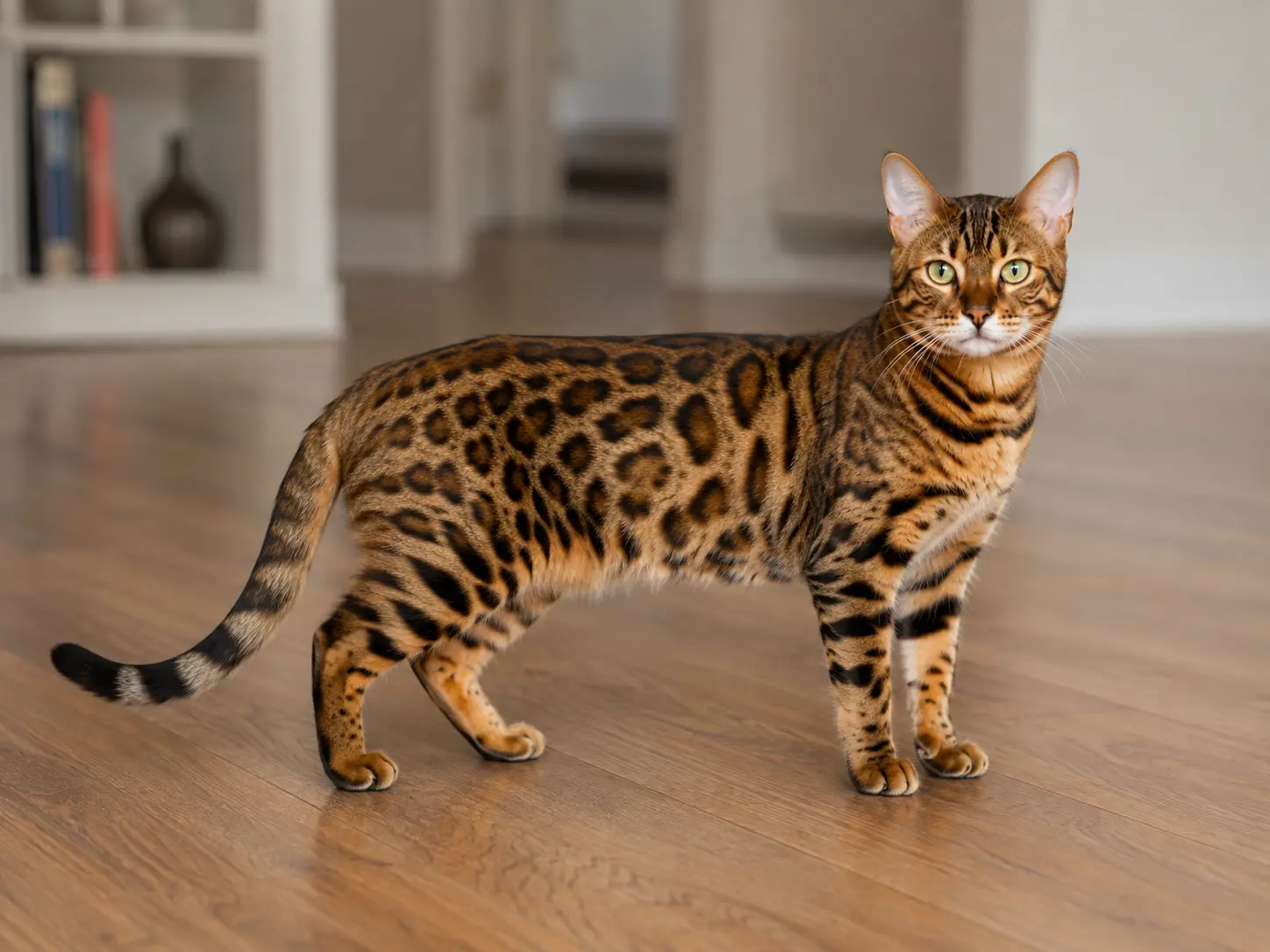
The Bengal is a cat breed with a typical lifespan of 12-15 years. This guide explains its everyday care needs, important health considerations, and the ownership choices that shape long-term costs.
How Much Does a Bengal Cat Cost?
A Bengal cat typically costs about $75–$300 through adoption or rescue and roughly $1,200–$3,000 from a responsible breeder. The purchase price varies with breeder reputation, pedigree, generation, health testing, color, location, and what veterinary care is included.
| Route | Typical price | Planning note |
|---|---|---|
| Adoption or rescue | $75–$300 | Shelter or Bengal rescue adoption may include spay/neuter, first vaccines, and microchipping, which can reduce startup costs. |
| Responsible breeder | $1,200–$3,000 | Ask breeders for HCM screening history, PRA-b and PK-def testing where relevant, written health records, socialization details, and generation information. Avoid sellers who market wild appearance or rare colors without health documentation. |
Bengal Kitten Price
A Bengal kitten from a responsible breeder commonly falls in the $1,200–$3,000 range used in this guide. Kittens sold for substantially more may be priced for pedigree, breeding rights, show potential, unusual coat traits, or early-generation ancestry, but a higher price does not automatically mean better health or temperament.
Before paying a premium, ask what is actually included: vaccinations, microchipping, registration, health guarantees, cardiac screening history, genetic testing, spay/neuter terms, and post-sale support.
Bengal Cat Cost by Generation
Bengal generation labels describe how many generations separate a cat from an Asian leopard cat ancestor. Earlier-generation cats can be less common, may face additional ownership restrictions in some locations, and can be priced differently from the later-generation Bengals typically kept as household pets.
| Generation | Typical market position | Cost planning note |
|---|---|---|
| F1–F3 | Earlier-generation / less common | Prices can be substantially higher and ownership rules may be more restrictive. Confirm local legality, breeder experience, temperament expectations, and veterinary access before purchase. |
| F4 and later | More typical companion Bengals | These are more commonly sold as household pets and are the better match for the general breeder-price range used in this guide. |
Because generation pricing varies widely by breeder and region, treat generation as one factor rather than a fixed price schedule. Health testing, socialization, breeder quality, and suitability for home life matter more than generation alone.
First-year cost breakdown
| Item | Low | High | Planning note |
|---|---|---|---|
| Adoption fee or breeder price | $100 | $3,000 | |
| Spay/neuter | $120 | $350 | |
| Initial vet exam and kitten vaccines | $180 | $320 | |
| Carrier, litter setup, bed, bowls, and scratching gear | $250 | $550 | |
| Food (first year) | $350 | $800 | |
| Tall cat tree, puzzle feeders, toys, and climbing setup | $200 | $700 | |
| Microchip and registration | $40 | $80 | |
| Flea, tick, and parasite prevention | $80 | $220 | |
| Optional HCM screen, DNA testing, or early diagnostics | $100 | $600 | |
| First-year scenario range | $1,420 | $6,620 | The low scenario uses the least expensive acquisition route plus lower setup and care estimates. The high scenario uses the highest acquisition route plus higher estimates. Adoption and breeder prices are alternatives, not costs added together. |
Monthly Cost of a Bengal Cat
A practical standard-care budget is about $192 per month. A leaner budget may be closer to $150 per month, while a premium setup with higher-end food, insurance or larger savings, more enrichment, and paid pet care can reach about $267 per month.
Monthly costs are driven mainly by food, litter, preventive veterinary care, enrichment, insurance or emergency savings, and replacement toys or climbing equipment.
Lifetime Bengal Ownership Cost
This guide uses a typical annual planning cost of about $2,300 and a planning lifespan of 13 years, which produces an estimated lifetime ownership cost of about $29,900.
This is a planning estimate rather than a guarantee. A Bengal that needs specialist heart care, repeated digestive workups, injury treatment, premium food, frequent boarding, or more intensive enrichment can cost substantially more over its lifetime.
Budget levels
| Care level | Monthly | Annual | What it includes |
|---|---|---|---|
| Budget | $150 | $1,800 | Mainstream food, routine preventive care, DIY grooming, basic litter, one durable climbing setup, and careful toy rotation instead of constant new purchases. |
| Standard | $192 | $2,300 | Higher-protein food, reliable clumping litter, puzzle feeders, vertical territory, preventive vet care, and a separate emergency reserve for injury or digestive workups. |
| Premium | $267 | $3,200 | Premium wet-heavy food, insurance or larger savings, cat shelves or a larger cat wheel setup, sitter visits during travel, and faster cardiology, eye, or digestive follow-up. |
Main cost drivers
| Category | Share | Lifetime estimate | Planning note |
|---|---|---|---|
| Food & treats | 33% | $9,867 | |
| Vet & medical | 28% | $8,372 | |
| Enrichment/toys | 16% | $4,784 | |
| Litter | 15% | $4,485 | |
| Boarding & misc | 8% | $2,392 |
How much does a Bengal eat — and what it costs
Typical daily amount: About 1/2 to 3/4 cup of dry food per day for many 8-15 lb adults, or an equivalent calorie amount split between wet and dry food.
| Food level | Monthly range | Examples |
|---|---|---|
| Budget food | $25-$40/month | Mainstream dry food with measured portions |
| Standard food | $40-$65/month | Higher-protein dry food plus some wet food |
| Premium food | $65-$100/month | Wet-heavy, limited-ingredient, or premium high-protein formulas when tolerated |
Annual range: $350-$1,200/year depending on wet-food share, protein level, brand tier, and digestive sensitivity.
Bengals are muscular, athletic cats, so food cost is not just about filling a bowl. Many do best with measured meals, puzzle feeding, and a higher-protein diet that supports activity without encouraging weight gain. Some households spend more on wet food, limited-ingredient formulas, or digestive-friendly diets if stress, fast eating, or stomach sensitivity becomes a pattern. For this breed, feeding can also be part of enrichment: treat mazes, slow feeders, and food puzzles help turn mealtime into hunting-style mental work.
Interactive training and enrichment costs for a Bengal
Budget $20-$100 for clicker training basics, puzzle feeders, target sticks, harness acclimation, and treat rewards. If scratching, door-dashing, aggression, fear, or litter-box issues appear, a feline behavior consultant may cost $75-$150 per session.
| Training option | Typical cost |
|---|---|
| Clicker training and enrichment basics | $20-$100 for a clicker, treats, puzzle feeders, target stick, and beginner resources |
| Private behavior consultation | $75-$150/session, often 2-4 sessions for aggression, fear, scratching, or litter-box issues |
| Online cat training programs | $25-$150 one-time for structured enrichment, harness training, or behavior support |
| Harness and travel training gear | $25-$90 for a secure harness, upgraded carrier, and training treats |
If training is delayed: Without enough stimulation, a Bengal may redirect energy into furniture damage, cabinet raiding, cord chewing, door-dashing, water-bowl messes, or stress-related behavior. Minor damage, replacement gear, and behavior support can add $100-$500+ per year in some homes.
Grooming costs for a Bengal
At-home care: Bengals have a short, sleek, pelt-like coat that is usually easy to maintain at home. Most owners only need a soft grooming glove or rubber brush, nail clippers, cat toothbrush, toothpaste, and occasional ear-cleaning supplies. Budget $25-$80 upfront for a basic kit.
Professional care: Professional grooming is optional for most Bengals because matting risk is low. Paid help is usually limited to nail trims, an occasional bath for a messy or senior cat, or handling support if the cat resists restraint. Nail trims or basic services usually cost $15-$60 per visit, while full cat grooming can cost $60-$120 in higher-cost markets.
Annual range: $50-$300/year for most households, with dental care budgeted separately under vet costs.
Coat and shedding: Shedding is usually light to moderate, and the coat is easier to manage than a Maine Coon or Persian coat. Weekly brushing, nail trims, dental care, and ear checks are the main routine tasks. Grooming is not the expensive part of Bengal ownership; enrichment and health planning usually matter more.
Bengal health risks and veterinary costs
Bengal health costs are mainly linked to inherited risks, extreme athleticism, and stress sensitivity rather than heavy grooming or body size. The practical financial move is to ask for HCM screening history, PRA-b and PK-def testing where relevant, generation information, and socialization details before purchase. After adoption, the most cost-protective routine is stable enrichment, consistent diet, predictable litter access, and prompt veterinary follow-up when vomiting, breathing changes, or sudden behavior shifts appear.
| Condition | Risk | Potential cost | What to watch for |
|---|---|---|---|
| HCM (heart disease) | Breed-relevant heart-disease risk; responsible breeders should discuss cardiac screening and family history | $300-$600/year for monitoring in some cases; $1,000-$3,000+ for diagnostics or specialist care if symptoms appear | Fast breathing, exercise intolerance, fainting, sudden weakness, poor appetite, or a heart murmur found at a vet visit |
| Progressive retinal atrophy | Breed-specific heritable eye risk; ask about PRA-b testing and eye history | $60-$150 for genetic testing; $150-$500+ for eye exams and supportive planning | Night blindness, bumping into objects, hesitating in dim light, or enlarged pupils |
| Stress-related GI illness | Higher risk when a Bengal is under-stimulated, stressed, or poorly matched to the household routine | $300-$1,500+ for exams, lab work, diet trials, medication, and repeat visits | Vomiting, diarrhea, appetite changes, hiding, overgrooming, or sudden litter-box changes |
| Bengal progressive neuropathy | Rare but breed-associated neurologic risk | $500-$4,000+ for neurologic exams, diagnostics, supportive care, and follow-up | Weakness, abnormal gait, stumbling, muscle loss, or difficulty jumping |
Insurance and emergency planning for Bengal
Typical premium: $25–$50 per month
Insurance is often worth comparing for Bengals because heart screening, specialist diagnostics, injury care, and stress-related digestive workups can create larger-than-average vet bills.
When to enroll: Compare plans before any heart murmur, eye disease, digestive condition, injury, or chronic finding is documented.
Coverage considerations: Insurers may scrutinize pre-existing heart murmurs, HCM findings, chronic vomiting or diarrhea, eye disease, previous injuries, and behavioral stress conditions documented before enrollment.
Emergency-fund alternative: If insurance does not pencil out, keep a separate $1,500-$3,000 emergency fund for urgent diagnostics, dental procedures, injury care, or chronic-condition workups.
For this breed, insurance is often easiest to justify when you focus on downside risk: HCM diagnostics, specialist care, injuries, and repeat digestive workups. A dedicated emergency fund can still be a practical alternative for some households.
Hidden costs of owning Bengal
- A Bengal often needs more than a basic scratching post. Budget $150-$600 for a tall cat tree, wall shelves, window perches, sturdy scratchers, and safe routes up and down because this breed uses vertical territory like living space.
- Plan $15-$35/month for wand toys, puzzle feeders, treat mazes, replacement springs, crinkle tunnels, kicker toys, and rotating enrichment. Bengals often get bored with static toys faster than quieter indoor cats.
- Under-stimulated Bengals may knock items down, scratch furniture, chew cords, open cabinets, climb appliances, investigate sinks, or raid food storage. Cabinet locks, cord covers, shelf anchors, furniture protection, and replacements can add $100-$500+ in some homes.
- Stress, abrupt diet changes, under-stimulation, or a chaotic household routine can turn into $300-$1,500+ in exams, lab work, fecal testing, food trials, medication, and repeat visits.
- Interactive cats often do better with reliable drop-in visits or boarding during travel. Budget $20-$40 per visit or $30-$60 per boarding night depending on market.
- Keep a separate $1,500-$3,000 emergency fund regardless of breed.
- The first year often feels more expensive because Bengal setup costs arrive early. Many owners buy a basic scratching post first, then realize they also need taller climbing furniture, heavier litter boxes, puzzle feeders, cabinet protection, cord covers, and a better play routine once the kitten starts using the whole room as territory.
- Routine care is only part of the budget. Grooming is usually light for this short-coated breed, but boarding, pet sitting, litter quality, enrichment, and activity-related accidents can rise quickly depending on travel frequency and household setup.
Bengal versus similar breeds
| Breed | Annual cost | Lifetime cost | Planning lifespan |
|---|---|---|---|
| Domestic Shorthair | $1,800 | $27,000 | 15 years |
| Abyssinian | $2,100 | $27,300 | 13 years |
| Maine Coon | $2,200 | $30,800 | 14 years |
How to save without under-caring
- Buy durable enrichment once instead of replacing cheap toys constantly. A stable $150-$300 cat tree and rotating puzzle feeders can prevent repeated impulse buys.
- Ask about HCM screening, PRA-b testing, and PK-def testing before purchase. Screening is usually cheaper than discovering avoidable risk after symptoms appear.
- Keep diet changes slow and consistent. Preventing digestive flare-ups can save $300-$1,500+ in repeat vet visits and food trials.
- Use scheduled play before meals. A free routine can reduce stress behaviors that lead to household damage or unnecessary vet visits.
- Compare insurance early. Bengals are a breed where one specialist workup can make early coverage easier to justify.
Is Bengal a good financial fit?
Bengals are best suited to households that can consistently set aside about $192/month for routine care and maintain a separate $1,500-$3,000 emergency reserve.
A stronger fit when
- Households that want an active, intelligent cat and can budget for daily enrichment.
- Owners willing to invest in climbing space, puzzle feeders, and consistent routines.
- People comfortable comparing insurance or keeping a strong emergency reserve.
- Families who want a realistic long-term budget before adopting.
Harder to sustain when
- Your pet budget is already tight.
- You want a very low-stimulation or low-engagement indoor cat.
- A moderate vet bill would be difficult to absorb without debt.
- You cannot provide climbing space, daily play, or enough environmental enrichment.
Frequently asked questions
Bengal cost questions
How much does a Bengal cat cost per month?
A Bengal typically costs about $192 per month on a standard-care budget, with many households landing between about $150 and $267 per month depending on food, litter, enrichment, insurance, and veterinary needs.
How much does a Bengal cat cost per year?
Bengals typically cost about $1,800 to $3,200 per year, with $2,300 as a practical standard-care planning estimate.
How much does a Bengal cat cost over its lifetime?
Using a 13-year planning estimate within a typical 12-15 year lifespan range, a Bengal costs about $29,900 over its lifetime on a standard-care budget.
How much does a Bengal cost in the first year?
The first year usually costs about $2,000 to $5,200, depending mostly on adoption versus breeder price, starter supplies, climbing setup, early vet care, parasite prevention, and optional health screening.
Are Bengal cats expensive to own?
Bengals are moderately expensive to own. Their routine costs are manageable for many households, but enrichment, food quality, litter, insurance, and breed-specific health screening can push costs above a basic indoor-cat budget.
How much does a Bengal eat per day?
Most adult Bengals eat about 1/2 to 3/4 cup of dry food per day, or an equivalent calorie amount split between wet and dry food. Exact portions should be adjusted for weight, age, activity, and body condition.
Is pet insurance worth it for a Bengal?
Pet insurance is often worth comparing for Bengals because heart screening, specialist diagnostics, injuries, and digestive workups can create larger vet bills. For some households, a dedicated $1,500 to $3,000 emergency fund can be a reasonable alternative.
How much should I budget for Bengal enrichment?
Plan on about $15 to $35 per month for toy rotation, puzzle feeders, scratching surfaces, climbing accessories, and interactive play items after the initial setup.
How much does it cost to groom a Bengal?
Most Bengal grooming can be done at home. Budget about $25 to $80 upfront for tools and about $50 to $300 per year for nail trims, occasional professional help, and replacement supplies.
Sources and trust
Breed and health references
Methodology
How these estimates are built
These planning ranges combine acquisition, first-year setup, recurring care, breed-specific risks and regional price differences. They are budgeting estimates rather than provider quotes.
Read the full methodology →